
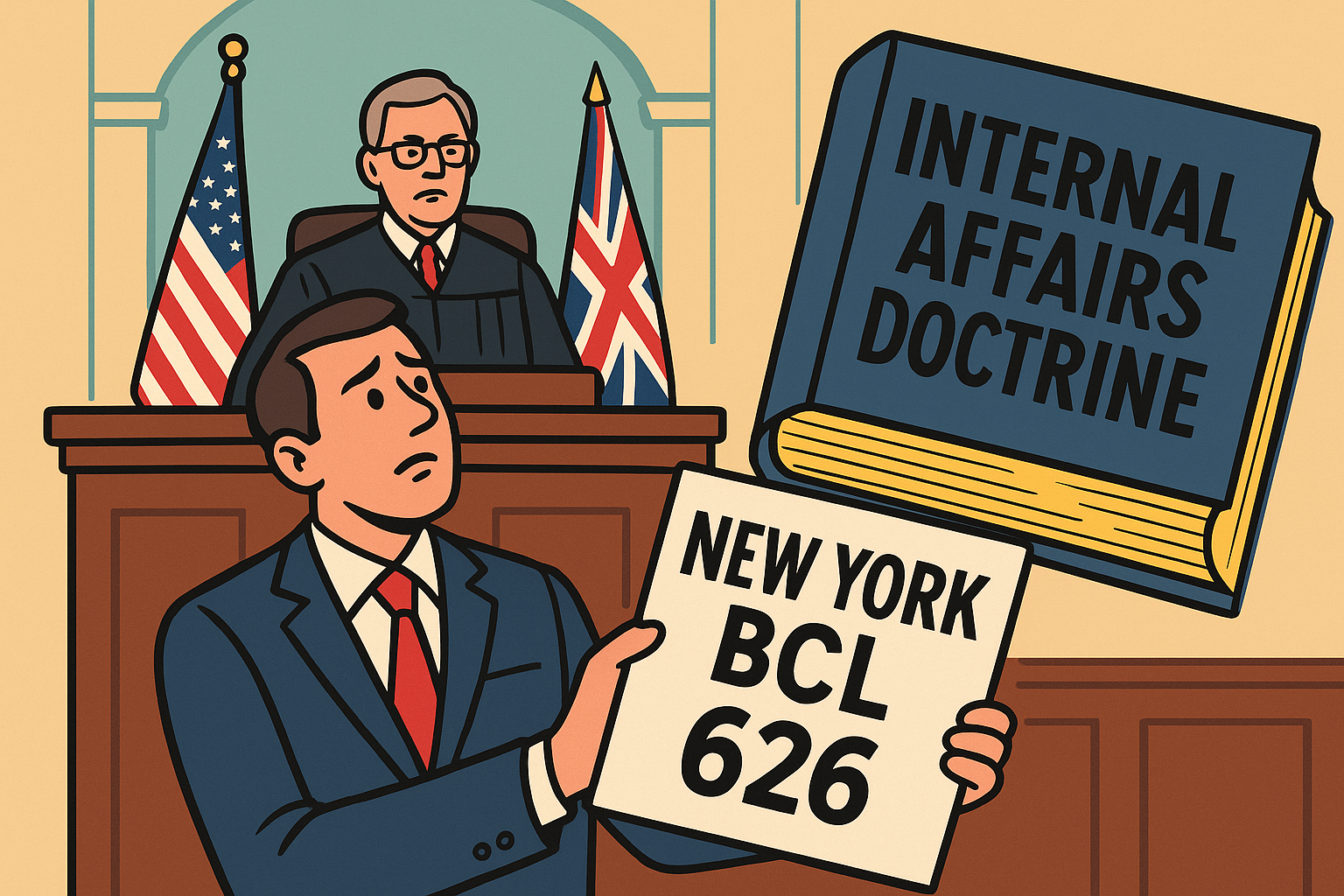
Dissolution May Be Sole Remedy When Minority Shareholder's At-Will Employment is Terminated
It's among the most common scenarios seen by business divorce lawyers: A minority shareholder of a non-dividend paying close corporation -- let's call him Joe the Shareholder -- for years has been a full-time employee, officer and director of a company he co-founded. Joe the Shareholder's salary and occasional bonus are the sole source of return on his investment in the company. Without any advance notice, the majority shareholders fire Joe the Shareholder, remove him from the payroll, cut off his access to the company computer and change the office locks. Joe the Shareholder can't believe that, as a company owner, he can be fired and thrown out by his business partners just like that. Joe the Shareholder wants to know what his remedies are and, in particular, whether he can sue for wrongful termination of his employment to recover lost salary and other damages.
Joe the Shareholder has a standard shareholders' agreement that gives a majority of the Board of Directors control of all company business affairs. The shareholders' agreement does not fix any definite term of employment for any of the company's shareholders, and it has no language limiting the Board's authority to terminate an officer or employee with or without cause. Joe the Shareholder has no separate employment agreement with the company.
So what's the answer to Joe the Shareholder's question? In New York, without any agreement for employment of a definite duration, Joe the Shareholder is considered an at-will employee of his own company who can be fired for any or no reason (except for reasons made illegal under federal and state workplace anti-discrimination laws), and therefore he has no claim for wrongful termination of his employment. If Joe the Shareholder has any remedy, he must look to his statutory right to seek judicial dissolution for shareholder oppression under Section 1104-a of the Business Corporation Law.
Employers' common law rights to terminate at-will employees are entrenched in New York case precedent stretching back over 100 years (e.g., Martin v. New York Life Ins. Co., 148 NY 117 [1895]). More recently, in Murphy v. American Home Products Corp., 58 NY2d 293 (1983), New York's Court of Appeals (the state's highest court) held that an employer has no implied obligation of good faith and fair dealing in an employment at will, and it rejected any tort claim for abusive or wrongful discharge of an at-will employee.
Six years after its Murphy decision, the Court of Appeals specifically addressed application of the at-will doctrine in the shareholder context in a case called Ingle v. Glamore Motor Sales, Inc., 73 NY2d 183 (1989). Philip Ingle started with Glamore Motor Sales as a sales manager in 1964, which was then owned 100% by James Glamore. In 1966, Ingle became a 22% shareholder, and later 40%. He paid a total of $75,000 for the shares. In 1982, the corporation issued new shares to Glamore and his two sons, reducing Ingle's holding to 25%. The shareholders' agreement included a stock repurchase provision giving the company the option to redeem the shares of any shareholder who "shall cease to be an employee of the Corporation for any reason". Ingle had no separate employment agreement.
In 1983, at a Board of Directors meeting, the Glamores voted Ingle out of his corporate posts and terminated his employment as operating manager. They immediately gave Ingle notice that the company was exercising its right under the shareholders' agreement to redeem Ingle's shares for $96,000.
Ingle accepted the payment but then sued for damages for breach of fiduciary duty and of contract. As summarized in the court's majority opinion, Ingle argued that
his employment status should not be governed by the employment at-will doctrine but, rather, that as a minority shareholder in a close corporation he should be treated as a co-owner, equivalent to a partner, whose employment rights flow from a special duty of loyalty and good faith. He [also] urges that an implicit covenant of good faith and fair dealing under the shareholders' agreement precluded his termination without cause, despite the express language and nature of the agreement in that regard. He concludes that even if he is an at-will employee, an action properly lies for the respondents' breach of fiduciary duties and for wrongful interference with his employment.
Five of the Court's seven judges rejected Ingle's arguments in favor of applying the at-will rule. Here's what they said:
A minority shareholder in a close corporation, by that status alone, who contractually agrees to the repurchase of his shares upon termination of his employment for any reason, acquires no right from the corporation or majority shareholders against at-will discharge. There is nothing in law, in the agreement, or in the relationship of the parties to warrant such a contradictory and judicial alteration of the employment relationship or the express agreement. It is necessary in this case to appreciate and keep distinct the duty a corporation owes to a minority shareholder as a shareholder from any duty it might owe him as an employee.
The Court then went a step further, by explicitly uncoupling its holding from the repurchase provision in the shareholders' agreement, as follows:
Under the established common-law rule—and without any reference to the shareholders' agreement—the corporation had the right to discharge plaintiff at will (Sabetay v Sterling Drug, 69 NY2d 329, 333; O'Connor v Eastman Kodak Co., 65 NY2d 724, 725; Murphy v American Home Prods. Corp., 58 NY2d 293, 305; Weiner v McGraw-Hill, Inc., 57 NY2d 458, 465-466; Martin v New York Life Ins. Co., 148 NY 117, 121).
The twist in this fact pattern is an asserted liability based on allegations that the corporate officers breached fiduciary duties of good faith and fair dealing arising from the shareholders' agreement and on tortious interference with Ingle's employment. The twist does not support a deviation from the governing principle in this case.
Calling this result "egregiously unfair," the two dissenting judges countered that "the relationship of a minority shareholder to a close corporation, if fairly viewed, cannot possibly be equated with an ordinary hiring and, in the absence of a contract, regarded as nothing more than an employment at will." They also noted that the "singular vulnerability of the minority shareholder in a close corporation" underlies the ""solicitude toward the rights of minority shareholders' shown by our Legislature in enacting Business Corporation Law §§ 1104- a, 1118" (citations omitted).
Which leads to my final point. The majority in Ingle noted that the case did not require it to decide any issue of the legal rights afforded a minority shareholder to seek judicial dissolution under BCL § 1104-a for oppressive conduct by the majority. Indeed, subsequent cases confirm that a minority shareholder's at-will employee status does not bar equitable relief of dissolution under § 1104-a, and that the shareholder's employment may be considered an incident of stock ownership, cloaking him with a reasonable expectation of continued employment. In other words, the majority's frustration of Joe the Shareholder's reasonable expectation of continued employment may not give rise to a claim for lost wages based on wrongful termination of employment, but it does enable him to seek relief by way of a proceeding for judicial dissolution which, in turn, will trigger the majority's statutory right to avoid dissolution by electing to purchase his shares for fair value under BCL § 1118.
High Court Restricts Remedies of Limited Partner Alleging Fraud by General Partner in Merger Transaction
On March 18, 2008, the New York Court of Appeals, which is New York's highest court, decided Appleton Acquisition, LLC v. National Housing Partnership (read decision here). The decision holds that a limited partner may not bring an action seeking damages or rescission based on allegations of fraud by the general partner in connection with a merger transaction, and that the statutory appraisal proceeding is the exclusive remedy for such claims. As a result, the plaintiff in Appleton, which acquired partnership interests post-merger from limited partners who did not exercise appraisal rights, was out of court and out of luck.
The limited partnership known as Beautiful Village ("BV") owned and managed a New York City apartment complex which received federal financing under HUD's Section 8 affordable housing program. By 2002, BV owed over $1.5 million to the corporate General Partner's parent company. Rather than foreclosing, the General Partner proposed that BV merge into a new limited partnership owned by the parent company, with each limited partner receiving $100 or 2.5 common units of the parent company for their BV shares. The limited partners received proxy statements disclosing the conflict of interest between the General Partner and its parent company, and advising that rejection of the merger would likely lead to foreclosure resulting in adverse tax consequences for the limited partners. The proxy also notified the limited partners of their alternative right to institute a judicial appraisal proceeding to receive the fair value of their partnership interests. None of the limited partners exercised their appraisal rights. In September 2002, the merger was approved and the limited partners' interests in BV were extinguished.
Three years later, plaintiff Appleton Acquisitions, LLC ("Appleton"), which had no prior involvement with BV, purchased from the former BV limited partners their equitable or partnership shares together with any legal claims they had against BV, the General Partner and its parent company. Appleton then filed a lawsuit against the latter entities asserting three causes of action for rescission of the merger and ancillary money damages on the grounds of fraud, breach of fiduciary duty and negligent misrepresentation. Appleton alleged that the proxy statement contained false and misleading statements and that the General Partner had depressed the value of the BV partnership interests by failing to enroll in a certain HUD program that would have provided BV with additional Section 8 rent subsidies. These allegations were also used to support two additional claims seeking monetary damages for breach of contract and aiding and abetting breach of fiduciary duty.
The seven judges of the Court of Appeals unanimously ruled that Appleton's first three causes of action seeking to rescind the merger were barred by New York's Revised Limited Partnership Act. Sections 121-1102(b) and (c) of the Act permit a limited partner who dissents from a proposed merger or consolidation to be cashed out for the "fair value" of his or her partnership interest. Section 121-1105 governs the procedure for payment and for the judicial determination of fair value absent agreement on the price to be paid. Section 121-1102(d) closes the door on other remedies as follows:
A limited partner of a constituent limited partnership who has a right under this article to demand payment for his partnership interest shall not have any right at law or in equity under this article to attack the validity of the merger or consolidation or to have the merger or consolidation set aside or rescinded, except in an action or contest with respect to compliance with the provisions of the partnership agreement or subdivision (a) of this section.
In so ruling, the Court contrasted Section 121-1102(d) with the counterpart dissenting shareholder provision in Section 623(k) of the Business Corporation Law. The latter statute, enacted long before the Revised Limited Partnership Act, codifies a common-law exception based on fraud or illegality and expressly recognizes that a dissenting shareholder may "bring or maintain an appropriate action to obtain relief on the ground that [the merger] will be or is unlawful or fraudulent." The Court found dispositive the "intentional legislative omission" of a similar exception in the Revised Limited Partnership Act.
The Court went on to note that limited partners who claim that a merger is tainted by fraud are not without a remedy. Under the appraisal statute, the court is to consider "the nature of the transaction giving rise to the [limited partner's] right to receive payment . . . and all other relevant factors" in arriving at its fair value determination. "This broad language", the Court added, "allows a dissenting limited partner to raise the issue of fraud, illegality, breach of fiduciary responsibility or other deceitful acts by the general partner that may have resulted in less compensation than the limited partner should have received". In a footnote, the Court suggested that, had BV's original limited partners exercised their cash-out appraisal rights, they could have utilized an expert appraiser to establish that the General Partner's failure to obtain additional Section 8 subsidies "negatively affected the valuation of their shares in [BV]".
The Court's unanimity fell apart, however, when it came to Appleton's two additional causes of action for monetary damages based on breach of contract and aiding and abetting breach of fiduciary duty. A four-judge majority concluded that these claims also were barred by the statutory scheme, stating that "[a]cceptance of the Limited Partners' argument would allow them to bypass the appraisal process even though they are asserting that the compensation they received for their shares was inadequate" and that the damages sought in lieu of rescission were "veiled attacks on the validity of the merger".
The three dissenting judges argued that the "plain language" of Section 121-1102(d) does not "expressly prohibit the availability of the common law right of a limited partner to seek damages as a result of a breach of contract premised on a general partner's alleged violation of a partnership agreement and the aiding and abetting of such breach by others". In their view, "[t]he Legislature surely did not intend section 121-1102 to insulate a general partner from an action for damages resulting from a breach of contract merely because the merger or consolidation was successfully completed".
An intriguing aspect of Appleton's dueling opinions is the voting lineup and how both sides rely on another recent split decision by the Court of Appeals in Tzolis v. Wolff. There, the Court held that members of LLCs have standing under common law to assert derivative claims notwithstanding the omission of any authorization in the LLC Law (see here for prior discussion of Tzolis) . While the tenor of the arguments in both cases suggest that the dividing line is the degree of judicial deference to legislative will, the voting pattern suggests otherwise: Judges Read and Graffeo were in the minority in Tzolis and the majority in Appleton; Judges Smith and Pigott were in the majority in both; and Chief Judge Kaye and Judge Ciparick were in the majority in Tzolis and in the minority in Appleton. Go figure.
LLC Members May Bring Derivative Suits
The New York Court of Appeals (the state's highest court), in a split decision with a vigorous dissent by three of the court's seven judges, today resolved the hotly debated question whether members of New York limited liability companies may bring derivative suits on the LLC's behalf. Answer: they may. Here's the decision in Tzolis v. Wolff, 10 NY3d 100 (2008).
A number of lower courts, in refusing to grant member standing to sue derivatively, interpreted the LLC Law's legislative history as indicative of the legislature's deliberate omission of statutory authority for derivative suits. The Court of Appeals majority held otherwise, finding the legislative history "too ambiguous to permit us to infer that the Legislature intended wholly to eliminate, in the LLC context, a basic, centuries-old protection for shareholders, leaving the courts to devise some new substitute remedy" (p. 11).
Waving the separation of powers banner, the dissenters accuse the majority of "judicial fiat" by "effectively rewrit[ing] the law to add a right the Legislature deliberately chose to omit", adding: "The proponents of derivative rights for LLC members -- who were unable to muster a majority in the Senate -- have now obtained from the courts what they were unable to achieve democratically" (p. 20).
The availability to LLC members of derivative rights will have a substantial impact on LLC member relations and the kind of litigation that may ensue when members seek judicial recourse. Without such rights, members holding minority interests in LLCs had little recourse against majority abuses that caused direct injury only to the LLC (e.g., taking excessive compensation or other forms of self dealing). The LLC Law's provision for judicial dissolution has not proved to be a potent remedy in the face of typical operating agreement provisions giving broad management control to the majority owners. Today's decision in Tzolis evens the playing field by providing an alternative avenue for judicial relief.
Update (September 26, 2008): For LLC derivative plaintiffs whose actions were dismissed for lack of standing pre-Tzolis, and whose appeals from the dismissals are still pending, the good news is that the Second Department earlier this week reinstated such an action. Stack v Midwood Chayim Aruchim Dialysis Assoc., Inc., 2008 NY Slip Op 07114 (2d Dept Sept. 23, 2008).
Update (October 16, 2008): New York County Commercial Division Justice Richard B. Lowe III's decision in Jacobson v. Croman, 2008 NY Slip Op 32805(U) (NY Sup Ct NY County Oct. 6, 2008), has an extended discussion of retroactive application of Tzolis, and collects several other cases on the subject.
Lawyers Suing Lawyers
A decision last week by New York’s highest court may have registered an uptick on the public’s schadenfreude meter, at least among the portion of the public who hold the legal profession in low esteem and who therefore might enjoy the sight of internecine warfare among splitting partners of a law firm.
In Ederer v. Gursky, 9 NY3d 514 (2007), Lawyer A joined and became a 30% shareholder along with Lawyer B (who then held 70%) of a small law firm organized as a professional corporation (PC). Several years later they re-organized the firm as a registered limited liability partnership (LLP) and took in three new partners who collectively held a 15% partnership interest, leaving Lawyer A with 30% and Lawyer B with 55%. Two years later, Lawyer A decided to leave the firm – according to him, because of a falling out with Lawyer B over a firm client; according to Lawyer B, because the firm was in financial dire straits for which Lawyer A was partially responsible – following which he entered into a written withdrawal agreement with the LLP setting forth various financial and case-sharing arrangements. Six months later, Lawyer A sued the LLP and each of its four remaining partners claiming breach of the withdrawal agreement and seeking an accounting and certain profit shares.
Garden variety financial disputes among former business or law partners do not usually garner the attention of New York’s Court of Appeals. This one did, however, because of the defendant partners’ reliance on a provision in the statute governing LLPs that, in general terms, shields partners of LLPs from vicarious liability for obligations of the LLP or for the negligence of their law partners. The case thus raised a novel question of statutory construction whether Section 26(b) of the Partnership Law was meant to protect only against partner liability asserted by third parties or whether, as the defendants argued, it also encompasses liabilities among the partners.
The Court’s decision traces the highly interesting history of partnership liability laws, including the nationwide surge of LLP formations in the aftermath of the savings and loan crisis of the 1980s when regulators went after deep-pocketed law firms to recover massive bank losses. In a 5-2 majority decision, the Court handed victory to Lawyer A by concluding that Section 26(b) only addresses a partner’s vicarious liability for partnership obligations to third parties and does not extend to claims among the partners of the LLP.
The dissenting judges note that Lawyer A’s withdrawal caused the firm’s finances to deteriorate and thereby rendered the firm unable to satisfy its obligations under the withdrawal agreement. They raise two provocative questions: Under these circumstances why should a former law partner be able to collect the firm’s debt from the “innocent” individual partners where a third-party creditor could not, and why should partners of an LLP be saddled with an obligation from which they would be shielded had the firm remained organized as a PC? The majority’s decision, laying emphasis on statutory construction rather than policy, means it will be up to the legislature to amend the law if it sees the same anomaly as do the dissenters.
Update (May 2, 2008): In Kuslansky v. Kuslansky, Robbins, Stechel & Cunningham, LLP, 50 AD3d 1100 (2d Dept 2008), the Appellate Division, Second Department, under the authority of the Court of Appeals' Ederer decision, reversed a lower court's decision dismissing an action brought by a former law firm partner for breach of contract based on the alleged failure of the defendants to pay him the value of his interest in the subject partnership as provided for in the parties' partnership agreement upon a partner's withdrawal from the partnership.