
Family-owned businesses are vital to the economy and I dare say the American way of life. According to a recent estimate, around 90% of all business firms in the U.S. are family owned, numbering over 30 million and generating 54% of U.S. gross domestic product and 59% of U.S. employment. While some of the largest are family controlled, publicly traded firms, e.g., the New York Times (the Sulzbergers), Fox (the Murdochs), and Walmart (the Waltons), the vast majority are small, privately held firms.
The business governance statutes in the U.S. make no distinction between family and non-family owned firms. Yet, professionals who counsel family-owned firms, be they lawyers, accountants, or other trusted business advisors, intuitively know that our business laws often do not address adequately the complex, relational dynamics unique to those firms.
Benjamin Means, Professor and John T. Campbell Chair in Business and Professional Ethics at the University of South Carolina Joseph F. Rice School of Law, has been studying and writing about family-owned businesses for over a decade. In 2013, I posted on this blog a two-part online interview of Professor Means and in 2016 a podcast interview, all on conflict in family-owned businesses (here, here, and here).
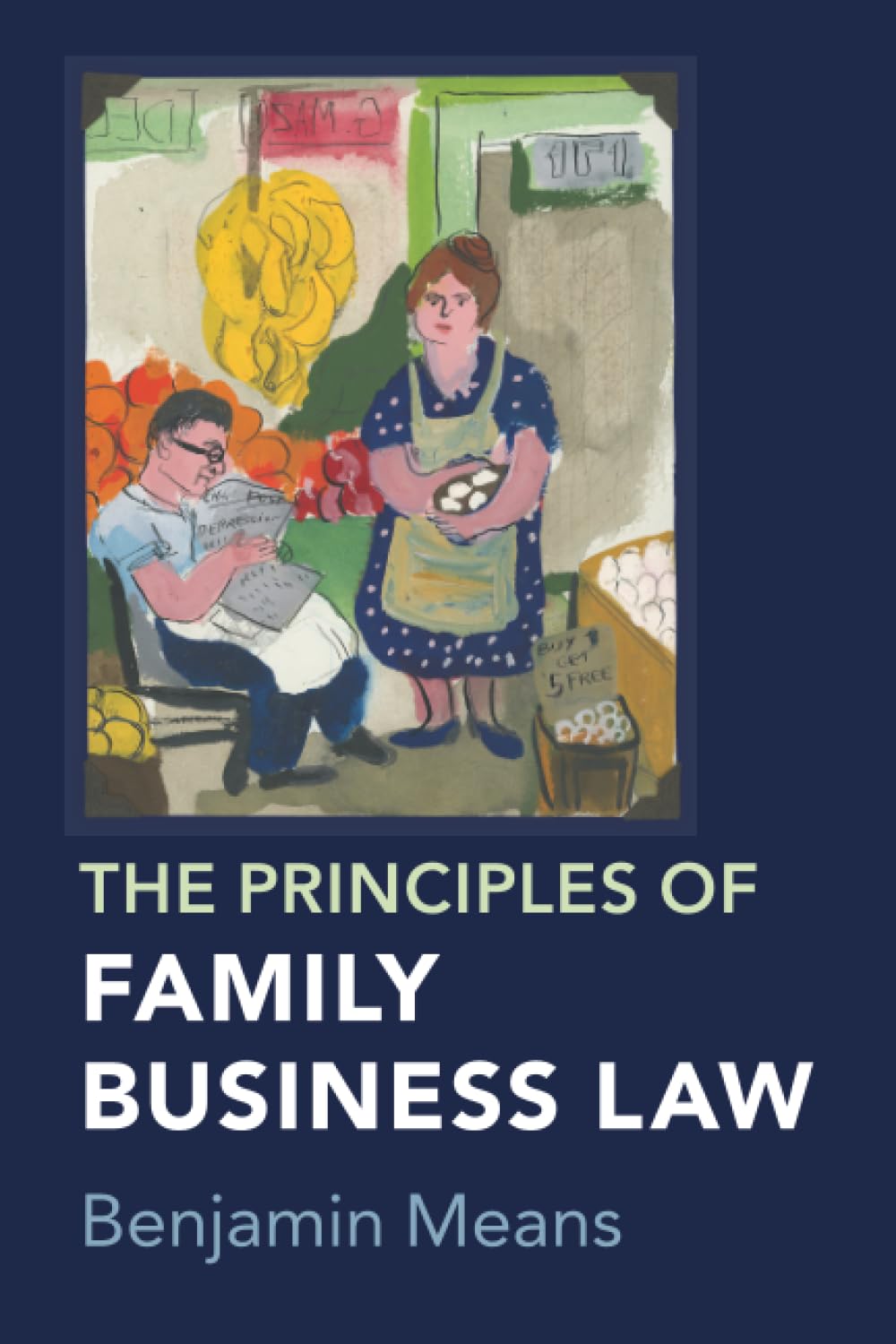
I take pleasure in sharing with my readers Professor Means’ latest and most ambitious work on the subject in his new book entitled The Principles of Family Business Law published by the Cambridge University Press. In its 243 bounteously footnoted pages, Professor Means examines how standard business law often fails to accommodate family dynamics surrounding issues of ownership, management, employment, and succession, and sets forth a model for improving firm governance and dispute resolution founded on principles of family intimacy, integration, and inheritance. From the book’s abstract:
The Principles of Family Business Law offers an accessible approach to legal issues that shape family businesses. Drawing on years of research, the book introduces three principles – intimacy, integration, and inheritance – that explain why family businesses are distinctive and how, with proper guidance, they can thrive. The book examines recurring problems such as role conflicts among family members, succession planning obstacles, and ownership disputes. Vivid case studies illustrate how legal rules interact with family dynamics in practice. Designed for scholars, students, lawyers, and business advisors, the book integrates insights from corporate law, family law, and estate planning, while remaining readable and grounded in real-world concerns. Whether used in the classroom or in practice, it provides essential tools for navigating the complex interplay of law and family business. By supporting the resilience of family businesses, the book affirms the family and community values they help to sustain.
The early chapters of the book focus on the distinctive features of family businesses and how the assumption of economically rational actors seeking their own wealth maximization, lying at the heart of standard economic theory and law, fails to account for the unique dynamics of family-owned firms. For example, Professor Means writes, “[a]n employer-employee relationship may also be a child-parent relationship” making it “unclear which role should take precedence in any given situation.” Family-owned firms frequently have no written agreements among the stakeholders or may assign rights and responsibilities at odds with the agreements. More broadly, he writes,
rather than seeking to separate what is status based and what is contractual, a better approach would widen the contractual lens and take relationships as the starting point for an integrated analysis. In that regard, we should seek to establish appropriate default rules for the interpretation and enforcement of family business bargains that presuppose a relational context.
The Professor’s integrated analysis is organized around three underlying principles designed to bridge the gap between family dynamics and standard business law:
- Intimacy: This principle recognizes that family business participants have deep, pre-existing personal relationships characterized by trust and shared history — I would add, at least in the early stages. Unlike standard commercial contracts, these relationships often lack formal bargaining because family members rely on informal “handshake” agreements rooted in their familial ties.
- Integration: Professor Means suggests that for these firms, business and family values are inherently intertwined and that there is need for governance structures that account for the overlap between contractual or common law obligations and personal loyalties. This includes managing role conflicts such as when a parent must also act as a boss.
- Inheritance: This principle addresses the long-term, multi-generational nature of many family firms. It focuses on the legal and emotional complexities of succession planning, such as the “King Lear Problem” where the failure to manage the transfer of power and wealth can lead to destructive family litigation.
The book is broadly organized into four parts — theory, application, legal frameworks, and societal impact. Each part includes one or more case studies featuring multi-generation, family-owned businesses, most of which are located in South Carolina and have participated in a novel teaching and advisory program of which Professor Means is Director called the Family and Small Business Program.
Being a business divorce lawyer, most of whose client matters involve family-owned businesses, the first chapter I read was the one entitled Dispute Resolution where I was gratified to see footnotes citing some familiar cases and even a couple of my own blog posts.
The chapter offers a typology of family business conflict beginning with shareholder oppression, broken down into “spillover” disputes in which “[b]reakdowns in family relationships can cause havoc in the workplace,” and “incompatible values” such as “dividing control equally among siblings, regardless of ability, or expropriating business assets and distributing them to members of the family to the exclusion of nonfamily or more distantly related minority shareholders.”
Next comes discussion of disputes arising from default no-exit rules bottomed on tax considerations, followed by disputes over a family member’s standing to bring suit where “the informality of a family business can lead to a lack of documentation of ownership interests.”
Next addressing the principles for adjudication by courts of disputes involving family-owned firms, Professor Means writes:
An understanding of the common sources of conflict in family businesses can help courts to apply the law. When assessing the merits of allegations brought by a plaintiff in a family business dispute, a court should first determine whether there is an improper motive for challenged business decisions. In a spillover dispute, for instance, the business justification defendants might offer would merely disguise what is more a family grievance than an independent decision concerning the best deployment of economic resources. Especially when the source of conflict seems unrelated to business operations, the courts should scrutinize the challenged transactions closely for the possibility of abuse of control.
In other chapters, Professor Means proposes adoption of what he calls “F Corp” statutes (F as in family) tailored to family-owned firms; explores the application of fiduciary duties of care and loyalty in the context of family-owned firms; discusses the critical issue of succession planning including the use of trusts; and suggests that business lawyers who counsel family-owned firms incorporate a “broader, multidisciplinary perspective” including “borrow[ing] aspects of the collaborative model developed for dispute resolution in the context of [marital] divorce.”
The Principles of Family Business Law is a book of multiple personalities. It is personal — Professor Means opens the book with the tale of his immigrant great grandparents and grandmother’s establishment of a successful delicatessen in Charleston, South Carolina. It is entertaining — here I refer to his use of King Lear and HBO’s Succession to teach the lessons of disastrous succession planning. It is professorial — both in its discussion of the law and its hundreds of footnotes citing a vast trove of law review articles and other scholarly publications. It is practical — Professor Means’ writing is both accessible, and offers solid advice, to lawyers and non-lawyers alike. It deserves a prominent place in your library or on your e-reader.
SAVE THE DATE! The annual LLC Institute will be held this year in Washington D.C. on October 15-16. The panel line-up will include a session on family business law featuring Professor Means.