
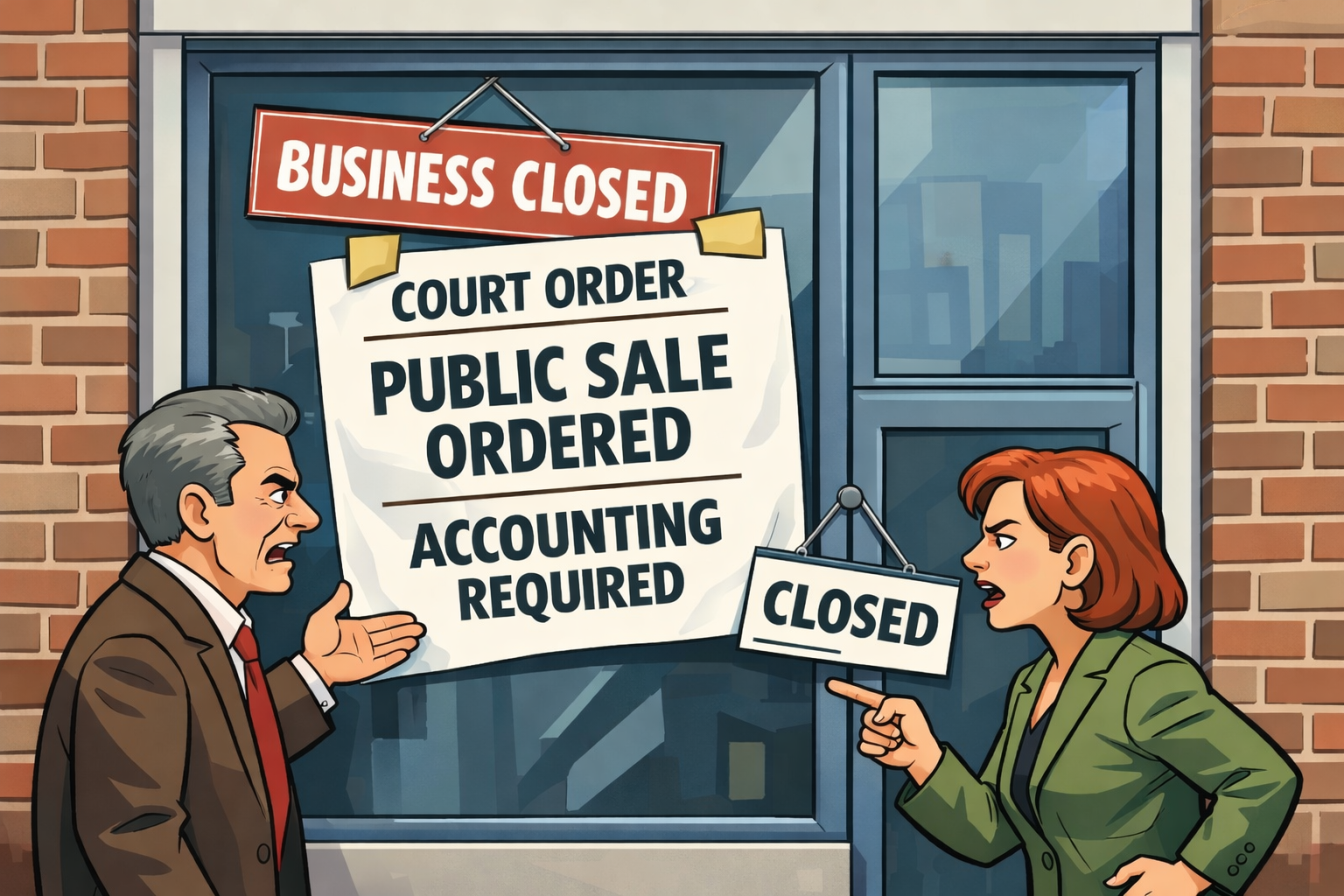
A dissolved corporation doesn’t simply vanish. It enters the winding-up phase, where the corporation must “proceed to wind up its affairs . . . sell its assets for cash at public or private sale, discharge or pay its liabilities, and do all other acts appropriate to liquidate its business” (BCL 1005[a] [applicable to judicial dissolutions by BCL 1117[a]).
The seemingly straightforward process of winding up is not immune to disputes between the shareholders, especially in cases where dissolution is brought about by conflict between the shareholders in the first place. Feuding shareholders often try to win the dissolution itself.
A recent Brooklyn Supreme Court case Passalacqua v Salnick Realty Corp., 2026 NY Slip Op. 30460[U], 6 (Sup Ct, Kings County 2026) confronts a familiar but under-appreciated reality of business divorce: years after a corporation is technically dissolved, the shareholders may still be battling over who paid what, who gets reimbursed, and how the last remaining asset gets sold. The decision holds useful insight on three post-dissolution fundamentals: when (and how) a dissolution can be annulled, the court’s supervisory power under BCL 1008, and why, when shareholders are deadlocked in the winding-up phase, a public sale—not a private deal—is the default endgame.
The Basics.
Where disputes arise in the winding-up phase, BCL 1008 gives the shareholders (and creditors claimants, directors, officers, and others [read here]), the right to petition the court to oversee the dissolution process. The same statute vests the court with broad authority to “make all such orders as it deems proper in all matters in connection with the dissolution or the winding up.”
Despite broad authorization in the statute, caselaw has defined—and in some cases sharply limited—the courts’ power to intervene in the dissolution process. For example, while BCL 1005 expressly contemplates liquidation by “private sale,” the Second Department in 2023 reversed a case where the trial court directed a sealed-bid auction for the company’s assets, finding that when the shareholders cannot agree on a liquidation process, the only available remedy is liquidation at a public sale (ANO, Inc. v Goldberg, 216 AD3d 766, 767 [2d Dept 2023]).
Finally, dissolution can in certain circumstances be undone. BCL 1008 (also made applicable to judicial dissolutions by BCL 1117[a]) provides the Court with authority to “suspend or annul the dissolution.” While somewhat rarely invoked, a judicial proceeding to annul dissolution can be a powerful tool for creative shareholders and creditors (see Sunwest Enterprises, Inc. v Tilani Enterprises, Inc., 282 AD2d 236, 239 [1st Dept 2001]).
The Corporation and the Dissolution Order.
Salnick Realty Corp. is a single asset real estate corporation that owns several vacant lots in Canarsie, Brooklyn. Two brothers, Joseph and Salvatore, each own 50% of the Corporation’s shares.
On December 23, 1992, Salnick was dissolved by proclamation of the Secretary of State based on its failure to pay taxes (see Tax Law 203-a). Despite the dissolution proclamation, Salnick never sold its property.
According to Salvatore, Joseph had essentially abandoned the property years before the dissolution proclamation—as early as 1985; he stopped making mortgage payments, and he wanted no further involvement in the operation of Salnick or the property. Joseph’s abandonment forced Salvatore and his wife to get a loan and make substantial contributions to Salnick to avoid foreclosure. All the while, alleged Salvatore, Joseph enjoyed rent-free occupancy of other more valuable properties owned by the brothers.
Salvatore currently uses the lots owned by Salnick to store equipment for his nearby construction business.
Infighting and Sale Deadlock.
In 2016, Joseph commenced litigation against Salvatore concerning several other jointly held businesses. In connection with that litigation, Joseph demanded that Salnick’s property be sold, and Salvatore rejected that demand.
Unable to agree on whether to sell the property, Joseph commenced a special proceeding under BCL 1008 seeking the Court’s order directing that the property be sold.
Salvatore shot back with counterclaims arising from Joseph’s abandonment of the property. Salvatore opposed a court-ordered sale with two arguments: First, he was working with the Department of State to pay back taxes and get the dissolution proclamation annulled—it was only a matter of time before Salnick was returned to good standing. And second, even if Salnick needed to be wound down, Joseph’s abandonment of the Corporation constituted “unclean hands” sufficient to bar him from participating in that process.
Annulment Does Not Arrive in Time.
Based on his representations that he was working with the Department of State to have the dissolution of Salnick annulled, Salvatore argued that the winding up provisions of BCL 1005 to 1008 did not apply.
Notably, while the Court arguably had independent authority pursuant to BCL 1008 to “suspend or annul” the dissolution of Salnick, Salvatore did not invoke that authority; he simply asked the Court to wait until the Department of State completed its process under Tax Law 203-a(7).
In a decision dated February 2, 2026, Brooklyn Supreme Court Justice Steven Z. Mostofsky held that Salvatore ran out of time in his attempts to annul the dissolution of Salnick. Justice Mostofsky noted that Salvatore’s paying back taxes wasn’t enough; “it was only upon a corporation’s obtaining a certificate of consent from the tax department and the filing with the New York Department of State” that annulment of a dissolution occurs (Tax Law 203-a[7]). Salvatore advised the Court in April 2025 that the process should take six to eight weeks, but by January 2026 the Corporation had still not returned to good standing.
So, held the Court, “Salnick must be considered a dissolved corporation” and the winding up and court supervision provisions of BCL 1005 through 1008 apply.
A Public Sale Is the Only Way Forward.
Next, Salvatore argued that Joseph was barred by unclean hands and other equitable considerations from seeking a court-ordered sale of the property. According to Salvatore, Joseph’s abandonment of the Corporation, rent-free use of other properties, and failure to pay his share of the Corporation’s expenses barred him from having a say in the winding-up process.
Justice Mostofsky disagreed. Those contentions, held the Court, were not “a legal basis for finding that petitioner’s failures in this regard would warrant a forfeiture of his rights as a shareholder.” And BCL 1008 bestows on all shareholders the right to petition the Court to oversee the winding-up process.
Salvatore’s protests about fairness rung hollow in the face of the facts: a dissolved corporation sitting on a property that should have been sold 30 years ago, and bitter deadlock about how (and whether) the winding up should occur.
In those circumstances, the Court underscored that there really was only one option: “When the parties cannot reach an agreement amongst themselves with respect to the sale of the corporation’s assets either to one another or to a third party, the ‘only authorized disposition of corporate assets is liquidation at a public sale.’” (citing Matter of Ravitz v Furst, 65 AD3d 1049, 1050 [2d Dept 2009]; ANO, Inc. v Goldberg, 216 AD3d 766, 767 [2d Dept 2023]).
A Final Accounting, But Be Careful What You Wish For.
The Court further granted Joseph’s demand for an accounting of the Corporation. But it keenly observed that such accounting may swing in Salvatore’s favor because the Court directed that the accounting specifically address any additional payments that Salvatore made to avoid foreclosure. The Court held, “to the extent that Salvatore made greater contributions to Salnick by paying off the mortgage, he is entitled to recompense for that in the distribution of any sale proceeds—either by adjusting the percentage of his ownership interest in Salnick or by repaying that amount prior to distribution of the remaining proceeds based on their respective ownership interests in Salnick.”
The accounting presumably also will account for all the back taxes paid by Salvatore in its attempt to annul the dissolution of the Corporation.
That direction may soon land the shareholders back in Court disputing how to properly adjust for Salvatore’s additional contributions.
In the end, Salnick reminds shareholders that disputes in the dissolution process—however reminiscent of the battles that came before—often are resolved by a simple default: a public sale and an accounting.