
Litigation over who is—and who is not—a member of a limited liability company has become a defining feature of LLCs. The ease with which parties form LLCs, coupled with the informality with which they often operate them, has spawned a steady stream of cases turning on the deceptively simple but fundamental question, best posed by Professor Kleinberger: “is you is, or is you ain’t [a member]?”
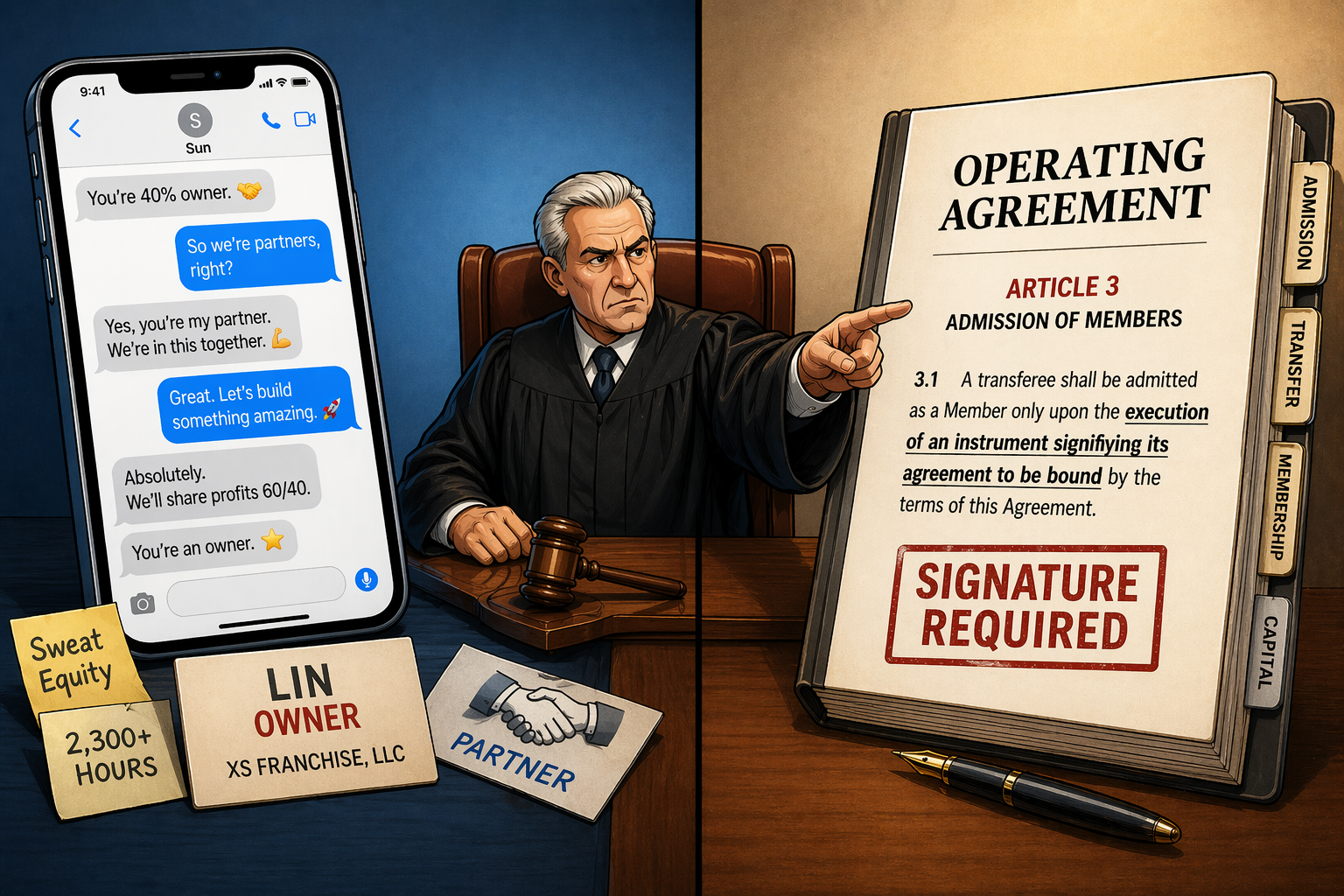
Those disputes feature a familiar clash: handshake deals and informal understandings on one side; operating agreements with rigid admission mechanics on the other. NYBD has seen (and covered) many cases—particularly at the pleading stage—of courts being willing to look past the latter, allowing claims of membership to proceed where the “informal” record compellingly suggests that the parties meant to bring a new member into the fold.
But perhaps we’ve reached a tipping point. A recent First Department decision, Matter of Lin v Sun, 251 NYS3d 676 (1st Dept 2026), suggests a shift away from informality and back toward strict compliance with the contractual mechanics of admission.
Lin, Sun, and the StretchLab Franchise
The dispute in Lin focuses on ownership of a StretchLab fitness franchise in New York’s Union Square. In November of 2022, Sun executed a franchise agreement with StretchLab that allowed him to open a studio in New York City. He then formed XS Franchise LLC as a single-member LLC that would operate the studio.
Lin alleges that in August of 2023, Sun offered her a 40% membership interest in XS Franchise, in exchange for her participation in the construction, management, and operation of the studio. According to Lin, she accepted Sun’s offer and immediately began working toward XS’s success as if she were a 40% member.
The Dispute
The trial court record leaves out most of the details behind the falling out between Lin and Sun. Lin alleges, however, that beginning in 2024, Sun physically attacked her after an altercation at the studio, which led to Sun’s arrest.
Following that altercation, Sun removed Lin’s access to the Company’s management software, security systems, and records. He then barred her physical access to the studio. Despite the Company becoming profitable, Sun refused to distribute any of those profits to Lin, disputing that Lin ever became a member of XS Franchise.
Sun’s Insistence on Lin’s Non-Membership
Lin sued, seeking not only a declaration that she was a 40% member of XS Franchise, but also the appointment of a receiver, the dissolution of XS pursuant to LLC Law 702, and damages—directly and derivatively on behalf of XS Franchise—for Sun’s alleged misconduct.
Sun moved to dismiss the petition, arguing essentially that two pieces of documentary evidence conclusively prove that Lin was never a member of XS Franchise:
- The Franchise Agreement between XS Franchise and StretchLab, which included specific requirements—payment of transfer fees, execution of franchise agreements, etc.—to become an owner of a StretchLab franchisee.
- The XS Franchise Operating Agreement, which contained this familiar provision: “[A] transferee shall be admitted to the Company as an additional Member upon its execution of an instrument signifying its agreement to be bound by the terms and conditions of this Agreement.”
Since Lin failed to comply with either the Franchise Agreement or the Operating Agreement’s requirements for admission as a member of XS Franchise, argued Sun, Lin never became a member of XS Franchise. And, therefore, the claims premised on her status as a member (including dissolution and the derivative claims) must be dismissed.
Lin’s Evidence of Membership
Lin disputed Sun’s attempt to rely on the formal requirements of those agreements. Irrespective of what the operating agreement said, Lin pointed to substantial evidence that she was in fact a member of XS Franchise, including:
- Lin’s contribution of capital during the renovation and more than 2,300 hours of labor;
- Business cards identifying Lin as an “owner;”
- Emails from Sun identifying Lin as his “partner” and a “co-owner;”
- Lin’s attendance at franchisor “owner training;” and
- A “partnership terms” proposal that Sun sent Lin memorializing the 60/40 profit split.
And, argued Lin, even if she technically failed to comply with the member admission requirements of the operating agreement, Sun either waived his right to insist on those requirements or should be estopped from relying upon them.
In Sun’s telling, by contrast, none of Lin’s indicia of ownership—business cards, alleged oral statements, or even substantial contributions of labor and capital—can overcome the absence of the one thing the Operating Agreement demands: a signed writing effectuating her admission as a member.
The Trial Court Order
New York County Commercial Division Justice Patel dismissed Lin’s petition. The Court held, that “the operating agreement . . . sets forth the procedure for adopting new members . . . including . . . execution of an instrument signifying its agreement to be bound by the terms and conditions of this agreement. Petitioner has likewise not alleged compliance with the aforementioned provision, nor does Petitioner proffer any allegation or evidence to the contrary.”
The Trial Court further held that Lin’s breach of contract claims “also fail based upon the Court’s determination that Petitioner does not hold an equity interest in the company pursuant to any contract, or has otherwise sufficiently alleged terms of any agreement.”
Formalities Matter, Says the First Department
Lin argued on appeal that the Trial Court improperly credited the admission requirements of the operating agreement over the substantial evidence that she became (or at least detrimentally relied upon Sun’s assertions that she had become) a member of XS Franchise.
Lin also criticized the Trial Court’s reliance on the Franchise Agreement: that agreement governed the relationship between XS Franchise and StretchLab, not the internal affairs of XS. Admitting Lin as a member might have been a breach of that Franchise Agreement, but it could not foreclose Lin’s membership entirely.
The First Department rejected both arguments, finding that the admission requirements of both the Franchise Agreement and the XS Operating Agreement were conclusive evidence that Lin did not become a member:
Articles 14.1 and 14.2 of the franchise agreement between respondent and StretchLab set forth requirements for the admission of new members and the transfer of an ownership interest in the franchisee entity, and petitioner did not allege that she complied with any of those requirements.
Similarly, article III(e)(2) of the XS Franchise’s operating agreement requires that a transferee execute an instrument stating that it agrees to be bound by the agreement’s terms and conditions, and petitioner did not allege that she executed any such instrument.”
But, Lin States a Claim for Breach of the Promise to Make her a Member
The First Department reversed, however, the Trial Court’s dismissal of Lin’s breach of contract claim. The Court held that Lin alleged the existence of a valid contract to transfer an interest in XS Franchise to her in exchange for her services and the payment of capital, her performance of those services and payment of capital, and Sun’s failure to transfer the interest.
So Lin could pursue claims focused on Sun’s failure to make her a member, but not the claims that required her to actually be a member.
Can Lin Be Squared with Sherman? A Return to Formalism or More Opacity for Member Disputes?
By my count, the last time the Appellate Division considered a similar case was its 2022 decision in Sherman v Zampella, which we blogged about here. In that case, the First Department affirmed Justice Borrok’s conclusion that alleged informal indicia of ownership—text messages, course of conduct, and admissions—constituted a prima facie showing that the plaintiff was a member in the LLC, overcoming the failure of the formal admission requirements in the operating agreement.
Lin goes decidedly the other way. In so doing, it signals a shift back toward formalism, elevating compliance with contractual admission procedures over equitable considerations. Notably, the Lin court gave no traction to arguments grounded in waiver or estoppel—doctrines that carried the day in Sherman.
Consider also whether the emphasis on formalities in Lin better squares with LLC Law 602(b)(1), which requires “compliance with the operating agreement” as a precondition to membership. The Revised Uniform Limited Liability Company Act (Section 102[13]) and the Delaware Code (Section 18-101[9]), meanwhile, invite more flexibility; both expressly contemplate oral and implied operating agreements.
Many LLC members enter into an operating agreement containing certain formality requirements, then exercise substantially less formality in their dealings. That reality often invites the argument that the member waived his or her right to insist on those formality requirements. Lin highlights the clear limitations of that argument in the context of admission of new members.
If Sherman blurred the lines of LLC ownership, Lin redraws them. But in doing so, it may leave even more uncertainty about when informal conduct will ever be enough.