
What happens when a law firm breakup combines self-help with firm funds, weaponized billing practices, a fatal deemed admission, and a federal court’s refusal to entertain dissolution? Ballon Stoll gives us the answer—and several cautionary lessons.

What happens when a law firm breakup combines self-help with firm funds, weaponized billing practices, a fatal deemed admission, and a federal court’s refusal to entertain dissolution? Ballon Stoll gives us the answer—and several cautionary lessons.

This week’s NYBD presents the 16th annual edition of Summer Shorts offering brief commentary on three recent decisions involving disputes among LLC members.

Some business divorce cases are about money. Others are about control. Today’s case, Homapour v 3M Properties LLC, 2026 NY Slip Op 04371 (1st Dept 2026), is about both.
As we often see with second and third generation closely-held family businesses, the informal trust and family hierarchy that may have helped build the enterprise
In this week’s New York Business Divorce, we encounter an unusual combination of adverse litigants: father and son versus mother and son duking it out in not one, not two, but three lawsuits simultaneously.
Continue Reading Multigenerational Intrafamily Business Dispute Defeated for Lack of Standing

Can an operating agreement require majority approval before a minority member may sue derivatively? A recent Delaware decision warns against letting authority provisions swallow the derivative claim whole.
Continue Reading The Derivative Claim and the Majority Approval Trap
Chef’s Table at Brooklyn Fare. It’s not just fining dining. It’s litigation warfare.

When cash never hits the books, can an accounting still deliver meaningful relief? A recent decision offers answers—and warnings.
Continue Reading Can an Equitable Accounting Find the Missing Cash?
How exclusive is the “exclusive” fair value appraisal remedy of Business Corporation Law § 623? So exclusive, according to the Second Department, that the statute bars a shareholder who consented to an asset sale from suing the other shareholder for making off with the sale proceeds after the closing. Let’s unpack this harsh result in this week’s New York Business Divorce.
Continue Reading Seller Beware: The “Exclusive” Fair Value Appraisal Remedy Really is Exclusive
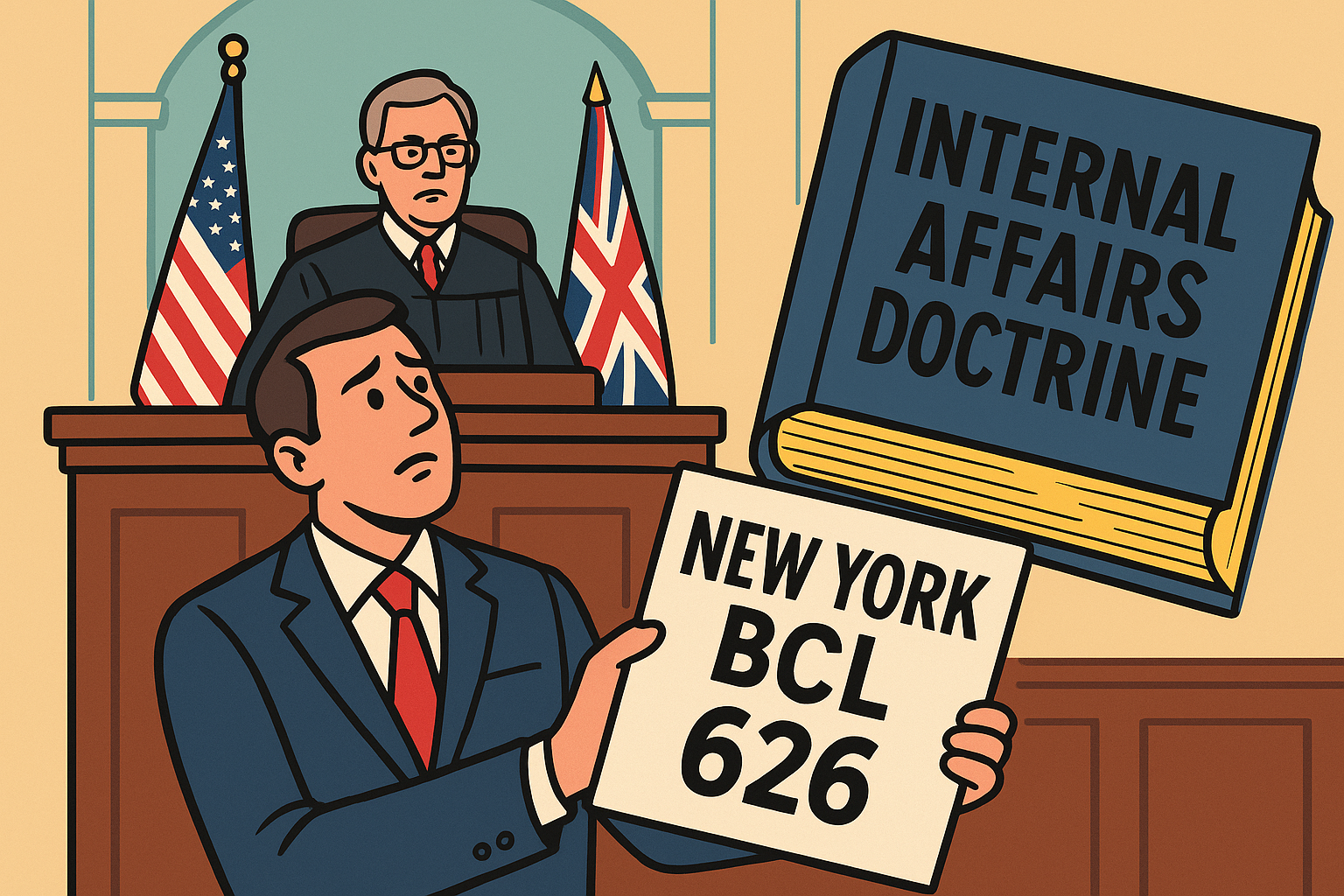
What must a shareholder show to maintain a derivative action on behalf of a foreign corporation doing business in New York? This week’s post unpacks the Court of Appeals’ emphatic reaffirmation of the internal affairs doctrine.

Pre-answer motions to dismiss for untimeliness are exceptionally common in business divorce litigation. Statute of limitations analysis can be deceptively simple in theory, but elusively difficult in practice, even for veteran judges. Identifying the applicable statute of limitations is just one of three steps a court must perform as part of its decision making process:
A recent decision from the Albany-based Appellate Division – Third Department, Lambos v Karabinis (___ AD3d ___, 2025 NY Slip Op 03367 [3d Dept June 5, 2025]), is a reminder to business divorce litigants – on either side of the v. – not to overlook that crucial third step in the statute of limitations analysis, which can rescue complaints from pre-answer dismissal even if they allege misconduct from decades earlier.
Continue Reading A Tardy Plaintiff’s Best Friend: The Open Repudiation Doctrine