Four sisters. One house. Who owns it?

Today’s case delves into a thorny situation many closely-held family businesses struggle with—proving ownership.

It’s no secret that many closely-held family business do not comply with corporate formalities. In the absence of such formalities, it can be difficult to demonstrate ownership without stock certificates in hand, or other

“Except as otherwise set forth herein” is a common proviso in agreements of all sorts. It can provide clarity. It also can cause dispute, as in the case highlighted in this post.

Continue Reading A Wolf in Sheep’s Clothing: Shareholder Agreement’s “Except as Otherwise Set Forth Herein” Hands Control of Famed Restaurant to Minority Shareholders

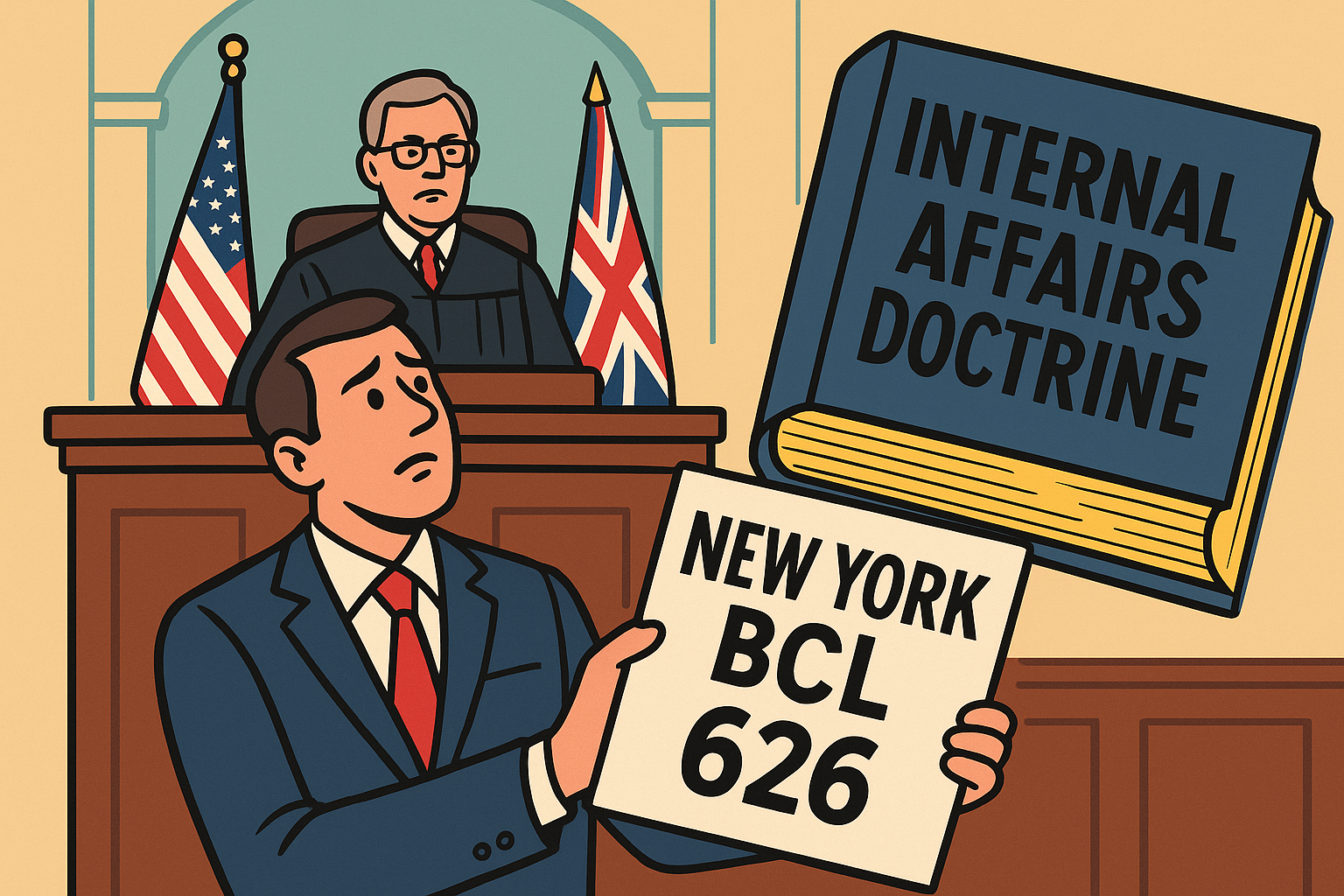
What must a shareholder show to maintain a derivative action on behalf of a foreign corporation doing business in New York?  This week’s post unpacks the Court of Appeals’ emphatic reaffirmation of the internal affairs doctrine.

Continue Reading Court of Appeals Again Bolsters Internal Affairs Doctrine, This Time Clipping Derivative Suits Brought on Behalf of Foreign Corporations

Section 417 of New York’s LLC Law permits the members to eliminate their fiduciary duties, but only in very narrow circumstances.  This week’s post shows how the seemingly toothless provision can carry the day. 

Continue Reading The Humble LLC Exculpation Clause Wins Big: Member/CEO Escapes $8M Fiduciary Claims

This week’s New York Business Divorce presents the 2025 Winter Case Notes, where we highlight a few recent decisions of interest featuring strict adherence to statutory language and the parties’ governing agreements.
Continue Reading Winter Case Notes: Nice Try, But the Agreements Say What They Say

The key question in shareholder oppression claims is often whether the complaining shareholder’s expectations were reasonable under the circumstances.  A recent decision from Albany County and a recently published article highlight two sides of a debate about how “contractual” the reasonable expectations inquiry should be. 
Continue Reading Can a Shareholder Be Oppressed After Ceding Control? Oppression, Reasonable Expectations, and Contractual Formalism

The shareholder oppression claim under BCL 1104-a has a unique relationship with claims for money damages.

A minority shareholder petitioning for dissolution under BCL 1104-a must establish that the majority shareholders have engaged in “illegal, fraudulent or oppressive actions,” or that the “property or assets of the corporation are being looted, wasted, or diverted for non-corporate purposes by its directors, officers or those in control of the corporation.”

Based on that standard, it’s easy to imagine conduct by the majority that both meets the criteria for dissolution and constitutes a separate tort compensable with money damages (for instance, a claim for the majority’s breach of fiduciary duty).  For that reason, it’s very common to see a dissolution petition coupled with money damages claims, all arising out of the same conduct. 

But where the money damages claims are filed before the dissolution petition, a plaintiff might be forced to litigate those to completion prior to pursuing their dissolution petition.  That’s the tough lesson learned by the petitioner of a dissolution proceeding brought under BCL 1104-a, in Ramirez v Issa, 2024 N.Y. Slip Op. 33488[U] [NY County 2024], the subject of this week’s post.Continue Reading Corporate Dissolution Petition Hits Back Burner in Favor of Earlier Filed Claims for Money Damages

It’s not every day that New York’s highest court considers a question impacting the business divorce cases that we typically litigate. But a recent decision from the Court of Appeals requires careful consideration by any owner of a foreign-incorporated entity considering New York litigation.  
Continue Reading Court of Appeals Bolsters the Internal Affairs Doctrine, Takes a Stroll Through Scottish Fiduciary Law

This week’s New York Business Divorce showcases how courts reign in aggrieved limited partners whose demands stray from the plain terms of the limited partnership agreement
Continue Reading You Get What You Get, and You Don’t Get Upset: First Department Boots Limited Partner’s Claims Based on Plain Terms of Limited Partnership Agreement