
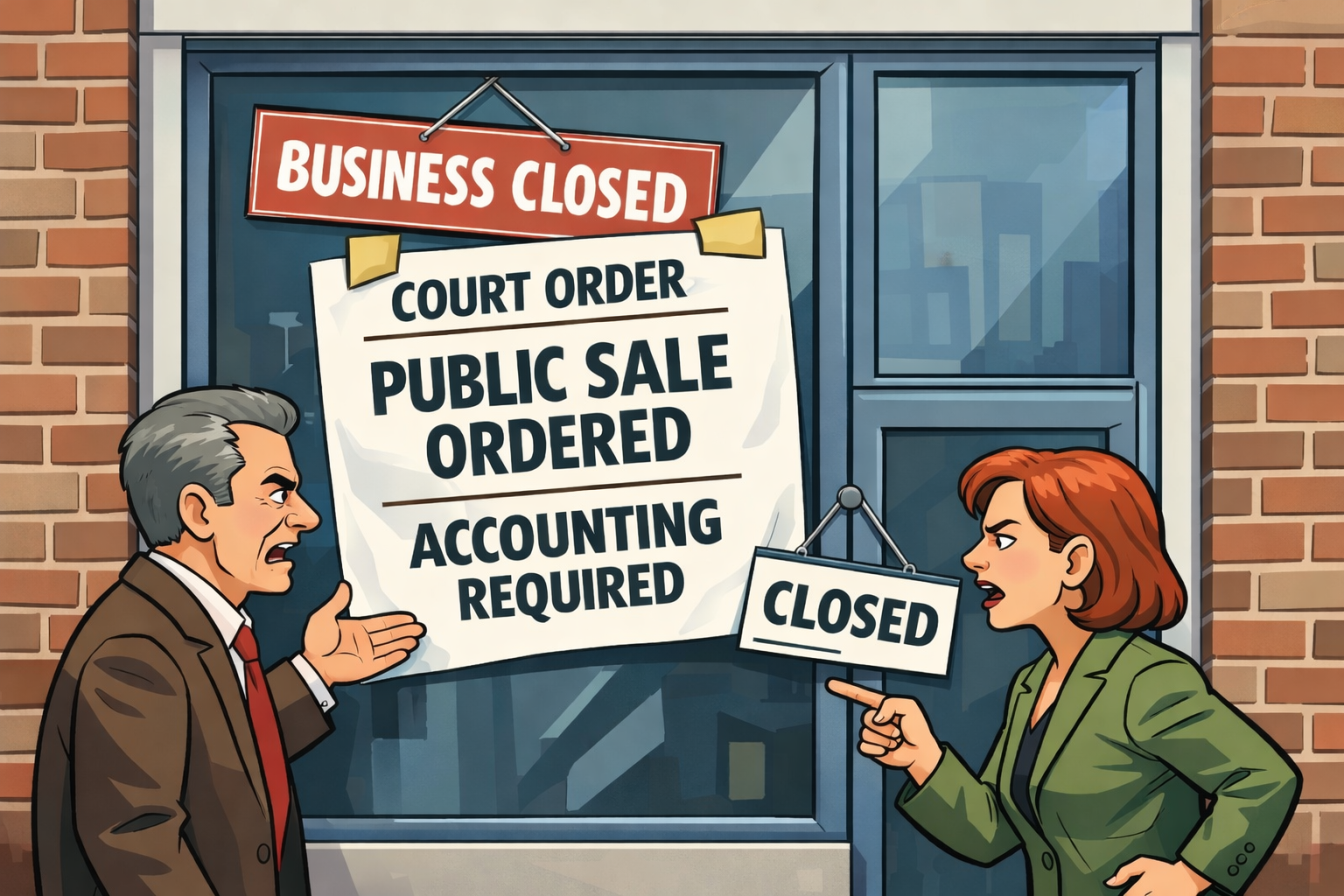
General partnerships are supposed to be the easiest of all business organizations for co-owners to separate. Not in the case featured on this week’s New York Business Divorce, where it took almost ten years for the majority partners of a New York general partnership to secure a court ruling that a formal written notice of withdrawal by one of the partners dissolved the business by operation of law.

Continue Reading The Pick-Your-Partner Principle

When an aggrieved party feels his or her back against the wall, there is a strong temptation to assert every claim under the sun against the adversary. Offense is the best defense, so they say. But when the claims don’t stick, litigants may find that more isn’t necessarily more… but it sure can tie up a case for years, particularly in the backlogged Second Department.

Today’s case—Waldorf Invs. L.P. v Waldorf—offers a solid back-to-basics review of the issues that can be litigated when a limited partnership goes south (and the viability of those claims), but at the cost, figuratively and literally, of 8 years of litigation.Continue Reading Second Department Denies Judicial Dissolution of Realty Holding Limited Partnership (and Related Claims), Ending 22-Count Dispute

Two recent cases, one from the Second Department and one from Suffolk County Justice Garguilo, shed light on some of the more nuanced issues in shareholder oppression litigation: the “equitable” prejudgment interest rate to be applied to a buyout under BCL 1118, and the relationship between a claim for dissolution and one for money damages.

Continue Reading Beyond Fair Value: When Shareholder Oppression Demands Interest and Damages

This week’s New York Business Divorce takes us to the Garden State for a delightfully-written, post-trial decision by retired, recalled Appellate Division Judge Clarkson S. Fisher, Jr.

Cheshun v Sikand, Opinion [NJ Super Ct, Monmouth County May 7, 2025]), was a dissolution proceeding under New Jersey’s version of the Revised Uniform Limited Liability Company Law (“RULLCA”) between two 50/50 LLC member-managers who founded and operated an entity they hoped would perform clinical drug trials, but which never really got off the ground.

A couple of lessons emerge from Cheshun.

First, it seems obligatory for close entity owners and their litigation counsel to throw stones, cast aspersions, and lay blame for the business’s demise. But like marriages, sometimes business relationships fail because of good faith disagreements and reasonable, dashed expectations. Sometimes nobody is to blame. And that is ok.

Second, business owners may agree to part ways, but the decision to do so does not sever the existence of one’s ongoing fiduciary duties. Fiduciary duties continue through the conclusion of the wind up process. In the words of Judge Fisher, where a business entity is in a “state of un-woundedness,” failure to heed one’s fiduciary duties – even after an agreement to separate – can prove costly.Continue Reading A Message of Acceptance from the Garden State

Spring in New York has ushered in a fresh crop of noteworthy decisions on intra-LLC disputes.  Headliners include a boost to members’ rights to compel an accounting courtesy of the First Department, a procedural refresher on LLC dissolution and the applicable standard, and a winding dispute over membership bequests in the Surrogate’s Court.

Continue Reading Demand Futility, Dissolution, and Transfer Restrictions: Spring Blooms Fresh Developments in LLC Litigation

It’s been 15 years since the Second Department’s decision in Matter of 1545 Ocean Avenue, LLC, 72 AD3d 121, 2010 NY Slip Op 00688 (2d Dept Jan. 26, 2010), which established the standard for judicial dissolution of limited liability companies.  Under that standard, a New York LLC should be judicially dissolved when the management of the company is unable or unwilling to permit or promote the stated purpose of the entity, or continuing the entity is financially unfeasible.

That standard has proved both enduring and highly fact-specific, producing over the last decade and a half a landscape of judicial decisions finding that specific conduct and circumstances do—or do not—warrant dissolution. 

I’ve also seen at least some disconnect between that standard and the real interests of many LLC members.  On the one hand, the standard focuses on two things: (i) the stated purpose of the LLC as set forth in the operating agreement, and (ii) the financial feasibility of the LLC.  On the other hand, in many cases, the “stated purpose” as set forth in the operating agreement is boilerplate that the owners never considered.  And the financial feasibility of the LLC usually is a given; people tend not to litigate over failing businesses. Most owners who resort to judicial dissolution do so for other reasons. 

Many LLC members seek judicial dissolution as a means to resolve distrust of or perceived misconduct by their co-owners.  And while there is room for consideration of those things in the “unable or unwilling” language of the dissolution standard, a court faithfully applying the 1545 Ocean Avenue standard and a party seeking his day in court about allegations of member misconduct might feel like they’re speaking different languages.

A recent decision from New York County, Otsuka v Shimura, No. 159202/2020 (Sup Ct, New York County 2025), serves as a fine springboard to highlight that disconnect, discuss the timing of an LLC dissolution claim, and take stock of the current LLC dissolution landscape.Continue Reading Stated Purpose vs. Stated Problem: Court Sticks to the Script for LLC Dissolution

This week’s New York Business Divorce post examines a recent appellate court decision in which the Third Department searches the record to find deadlocked 50/50 members unable to carry on a realty LLC’s business, warranting dissolution.
Continue Reading Help Comes From an Unexpected Place in LLC Deadlock Dissolution: The Third Department

The key question in shareholder oppression claims is often whether the complaining shareholder’s expectations were reasonable under the circumstances.  A recent decision from Albany County and a recently published article highlight two sides of a debate about how “contractual” the reasonable expectations inquiry should be. 
Continue Reading Can a Shareholder Be Oppressed After Ceding Control? Oppression, Reasonable Expectations, and Contractual Formalism

November was a whirlwind month for New York LLC litigation.  It featured disputes over how to wind up a judicially dissolved LLC, a bitter intra-family emergency indemnification/advancement injunction, and the finale of a decade-long battle over the enforceability of a partially baked operating agreement.  Some of these recent cases add clarity to the growing body of New York LLC caselaw. Others add confusion.  But all add precedential footholds for future arguments in disputes between members of New York LLCs. Members and their counsel take note.Continue Reading A Leaf Through a Busy November in New York LLC Litigation