

A New Framework for the Family Business Enterprise: A Review of Benjamin Means’ “The Principles of Family Business Law”

Family-owned businesses grab more than their fair share of business divorce matters. In his new book called The Principles of Family Business Law, Professor Benjamin Means examines the uncomfortable fit between, on the one hand, standard economic theory and law based on the “rational actor” seeking to maximize wealth and, on the other hand, the idiosyncratic dynamics of family-owned firms.
Promise of Equity Falls to Operating Agreement’s Rigid Admission Requirements
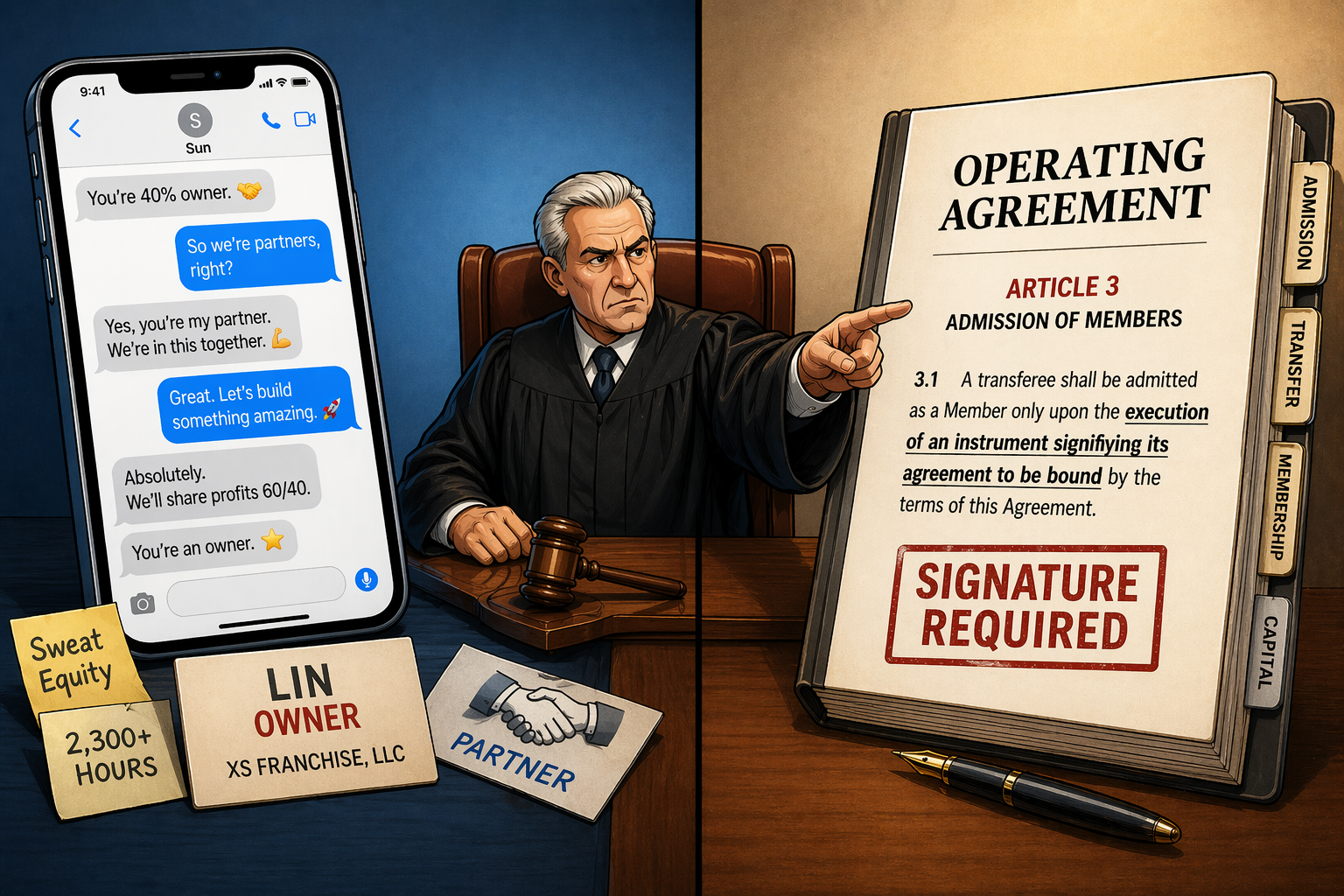
Litigation over who is—and who is not—a member of a limited liability company has become a defining feature of LLCs. A recent First Department decision suggests a shift away from informality and back toward strict compliance with the contractual mechanics of admission.
Continue Reading Promise of Equity Falls to Operating Agreement’s Rigid Admission Requirements
Mining for a Joint Venture: A Crypto “Partnership” That Never Got Off the Blocks

Every so often a case comes along that reads less like a business dispute and more like a cautionary tale about the perils arising out of unwritten deals among friends. As we’ve written about before, these cases can be brutal to defend, particularly where the pleadings just robust enough to survive a motion to
A Cross-Country Trio of Appellate Decisions Tackles Novel LLC Disputes

Three states, three LLC disputes, three appellate rulings. Who could ask for more?
Continue Reading A Cross-Country Trio of Appellate Decisions Tackles Novel LLC Disputes
Liquidated Damages or Unenforceable Penalty?

- You go to trial on behalf of your client, and win a hard fought victory: After a five-day jury trial, the jury returns a unanimous verdict in your client’s favor,
Can Majority-Authorized Action Still Breach Fiduciary Duty?

When an LLC operating agreement permits action upon majority consent, can a minority member nonetheless challenge that action as a breach of the majority’s fiduciary duties? The Fourth Department weighs in.
Continue Reading Can Majority-Authorized Action Still Breach Fiduciary Duty?
It’s War! Chef’s Table at Brooklyn Fare
Chef’s Table at Brooklyn Fare. It’s not just fining dining. It’s litigation warfare.
First Department Upholds Minority’s Unilateral Termination of Majority-Appointed CEO Over Majority’s Objections

Can a three-person minority outvote a four-person majority to oust the majority-appointed, longtime CEO of a profitable company (who also happens to be the founder of the company) in a vote requiring supermajority approval?
The math ain’t mathing, you may be saying to yourself.
But today, we explore a case—SJI Renewable Entery Ventures LLC,
Winter Case Notes: A Partnership Masquerading as an LLC, and Other Recent Decisions of Interest

This week NYBD presents its annual Winter Case Notes summarizing several recent decisions of interest.